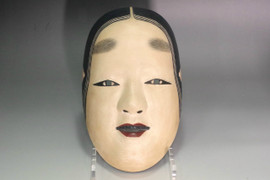
Japanese lacquered wooden Noh Mask Semimaru #5507
- SKU:
- 5507
- Condition:
- Used
- Shipping:
- Free Shipping






width: approx. 14.2 cm (5.59 in)
height: approx. 20.8 cm (8.19 in)
weight: approx. 140 g
Information from the previous owner: It was acquired from an antique dealer in Tokyo
Story of Semimaru
Semimaru, the fourth son of Emperor Engi (Emperor Daigo, 885–930), was blind from birth. One day, under an imperial आदेश that Semimaru be abandoned on Mount Osakayama, the courtier Kiyotsura escorted him there. As Kiyotsura grieved, Semimaru gently told him that this, too, was the Emperor’s far-reaching consideration for the future. There, Kiyotsura shaved Semimaru’s hair, ordained him into the religious life, gave him a rain cape, a hat, and a staff, and then took his leave. Clutching his biwa to his chest, Semimaru fell to the ground in tears. Later, the court noble Hiromasa no Sanmi, coming to see how Semimaru fared, was so moved by his pitiful condition that he prepared a humble hut to shelter him from the rain and dew, and invited him inside.
Meanwhile, Sakagami, the Emperor’s third child, had been born a princess, but because her hair grew in a strange reverse direction, she had become deranged and was condemned to wander in remote places. Leaving the capital and arriving at Mount Osakayama, Sakagami caught the sound of a biwa drifting out from the hut and realized that her younger brother Semimaru was there. Calling out to him, she entered, and the two took each other’s hands, speaking sorrowfully of their desolate fates.
But they could not remain together forever. At last, with tears in their eyes, they parted, each thinking tenderly of the other.
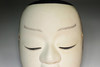
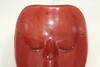
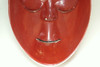
This Japanese Noh mask represents Semimaru, rendered with an elongated oval face, gently closed eyes, and slightly parted lips. The restrained modeling creates a quiet yet dramatic expression, a defining characteristic of traditional Japanese Noh mask art. The smooth white surface is accented by finely drawn eyebrows and hairline details, while the red lips and dark interior of the mouth provide a striking visual contrast that strengthens the mask’s composed, contemplative presence.
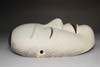
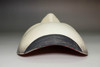
The reverse is finished in vivid red, creating a powerful contrast with the serene white front and emphasizing the structural beauty of the mask itself. The subtle contours of the cheeks, nose, and mouth allow shifting light and shadow to animate the expression, an important aesthetic feature in Noh theater masks and Japanese performing arts objects. This interplay of carved form and painted surface is one of the craft values that collectors often appreciate in a Semimaru Noh mask.
Well suited for display in a tokonoma, tea room interior, or Japanese art collection, this Japanese Noh mask offers strong appeal for collectors searching for Semimaru mask, traditional Japanese theater mask, hand-finished Noh mask, and classical Japanese stage