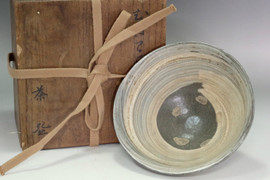
Kiyomizu Rokubey (1875-1959) Vintage brush marked teabowl #5002
- SKU:
- 5002
- Condition:
- Used
- Shipping:
- Free Shipping




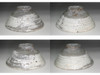
Width: approx. 13.8 cm (5 7/16 in)
Height: approx. 6.2 cm (2 7/16 in)
Weight: 300g
Kiyomizu Rokubey
1875-1959
male
kyo pottery
Born as the eldest son of Rokubey IV and became the fifth-generation Rokubey in 1913. Used the artist name Rokuwa.
He studied painting under Kono Bairei from his youth, and was initiated into pottery by his grandfather and father. In 1895, he exhibited his works in the fourth National Industrial Fair and won a prize. He was inspired by the works of Miyagawa Kosan and Seifu Yohei, who were the most active at the time, and decided to truly devote himself to ceramics.
His style included many new experiments and challenges, such as Otowa ware, which incorporated glazing techniques from unlined cloisonne-style majolica pottery; Taisho celadon porcelain, a warm style that used unique celadon glaze; and elegant Tairei porcelain.
He also requested the establishment of a crafts department in government exhibitions (the Bunten exhibition) and took part in planning the establishment of the Japan Crafts Association alongside Tsuda Shinobu, who was from a metalsmith family, and Takamura Toyochika.
Because of their activity and appeals, an art and crafts department was established in the 1927 Imperial Academy exhibition, the fourth department after Japanese paintings, Western paintings, and carving.