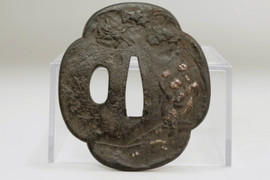
Antique TSUBA iron samurai sword guard #5066
- SKU:
- 5066
- Shipping:
- Free Shipping


- size: approx. 7.92cm (3 1⁄8in) x 7.98cm (3 7⁄64in)
- thickness: approx. 4.3cm (1 11⁄16in) - 3.4cm (1 11⁄32in)
- center hole: approx. 0.88cm (11⁄32in) x 2.8cm (1 7⁄64in)
- weight: 88g (w/ box 151g)
The design resembles the waterwheel of Yodo, characteristic of Kanayama tsuba from the Muromachi to mid-Edo periods. While Kanayama tsuba are typically small and somewhat thick, this tsuba features a design popularized after the mid-Edo period, with the iron gradually thinning from the seppa-dai to the outer edge, suggesting it is a later work.
Kanayama Tsuba
There are various theories about the origin of "Kanayama Tsuba." One theory suggests that during the Sengoku period, sword fittings craftsmen from Owari Province, who served the Atsuta Shrine, lived within the Kanayama Shrine area (now Minami-ku, Nagoya City) and made tsuba as a sideline due to increased demand, leading to the name.
Another theory posits that it refers to craftsmen who made tsuba within the Kanayama Shrine area under Inabayama Castle (now Gifu City) in Mino Province during the earlier Muromachi period. This theory is supported by the fact that Kanayama tsuba were used with Japanese swords made by Mino smiths.
Additionally, there is a theory that Kanayama Town, an iron distribution center along the upper Kiso River and the Hida River, is the place of origin.
In a broader sense, these works fall into the same category as Owari sukashi tsuba.
The most prolific period for their production was from the Sengoku period, peaking during the prosperity of Seki smiths, and continuing until the mid-Edo period.