A 400-Year-Old Innovation: The Unconventional Aesthetic of Kuro-Oribe Tea Bowls
22nd Sep 2026
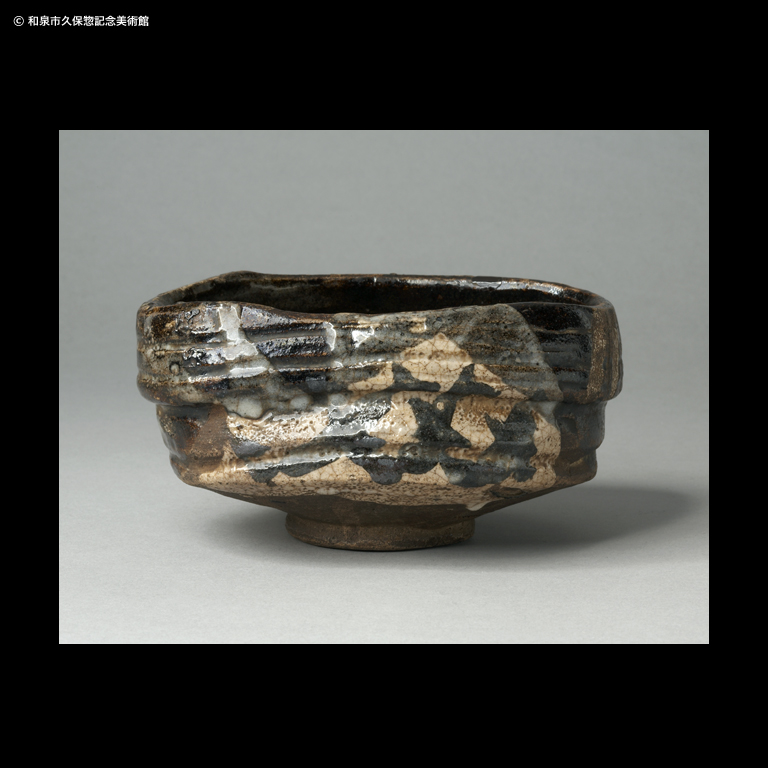
Kuboso Memorial Museum of Arts, Izumi https://www.ikm-art.jp/
There is a tea bowl that I’ve been head over heels in love with for years, even though I have never seen it in person.
It is a Kuro-Oribe (Black Oribe) tea bowl named "Zangetsu" (Morning Moon), dating back to the Edo period and housed in the Kuboso Memorial Museum of Arts, Izumi. Although I’ve only seen it through digital museum archives and exhibition catalogs, its overwhelming presence and aesthetic intensity shine right through the screen.
During the era when oribe ware was created, Japanese tea culture was undergoing an unprecedented wave of innovation. In contrast to the "tranquility and stripped-down beauty (wabi)" established by Sen no Rikyu, his disciple—the samurai tea master Furuta Oribe—introduced "dissonance and dynamism." With its intentionally distorted Kutsugata (clog-shaped) oval form, bold asymmetrical designs, and vibrant contrasts between green and black glazes, Oribe ware was truly "cutting-edge, avant-garde art" to the tea practitioners of that time.
"Zangetsu" perfectly encapsulates the signature charm of Oribe ware. The defining feature of Kuro-Oribe is the contrast between its lustrous, jet-black glaze (kuro-yu) and the white paneled section (mado), where motifs are painted with iron underglaze and covered with clear glaze. On "Zangetsu," one side features a deep, tightened black, while the white panel on the other side is decorated with geometric patterns (said by some to resemble stone walls or abstract motifs).
A pale morning moon (white panel and design) floating faintly in the dim dawn sky (black glaze). Viewing its stance after learning the name "Zangetsu" brings the moment of yohen (kiln-transformation) from 400 years ago into sharp focus, overlapping with the poetic scene envisioned by the tea masters of that era.
On a side note, are you familiar with the Japanese anime Hyouge Mono? It’s one of my absolute favorite works. Many of you might know it, but the main character is Furuta Shigenari (Furuta Oribe), a samurai and tea master who pursues beauty while interacting with historical giants like Toyotomi Hideyoshi and Sen no Rikyu (I especially love its heavy dose of humor).
In the anime, when granted a court title, he is told he can choose any title he likes. Since he was captivated by the olive-colored glaze at the time, he chose the title "Oribe-no-kami" simply because "Oribe" sounded like "olive". While the name "Oribe ware" is widely believed to originate from Furuta Oribe, its historical accuracy remains uncertain.