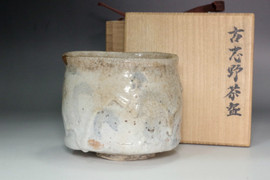
Hirasawa Kuro (1772-1840) Japanese Shino Chawan Tea Bowl #5547
- SKU:
- 5547
- Condition:
- Used
- Shipping:
- Free Shipping

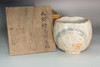
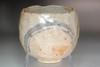
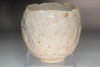
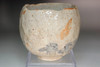
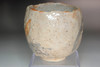
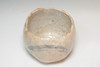
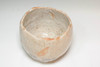
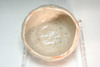
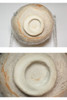
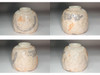
width: approx. 9.4cm (3.7in)
height: approx. 8.3cm (3.3in)
weight: approx. 246g (w/ box 417g)
condition: Very good
Accessories: Matching Wooden Box
Shipping: Shipped from Japan with a tracking number. We take great care in professional packaging to ensure the item arrives safely.
This is an exceptional Japanese Shino Chawan (tea bowl) crafted by Hirasawa Kuro II, a highly celebrated samurai-potter from the Owari domain active during the late Edo to Bakumatsu period. The Hirasawa family line was renowned for serving the domain while passionately immersing themselves in the refined culture of chanoyu (tea ceremony). They created tea utensils deeply inspired by the ancient traditions of Seto and Mino wares, developing a highly praised, rustic style known for its poetic elegance.
This tea bowl showcases an organic, handsomely distorted form reminiscent of the traditional "tezukune" (hand-kneaded) technique, striking a masterful sculptural balance. For discerning collectors and tea ceremony practitioners, the ultimate charm lies in its exquisite glaze expression. The soft, milky Shino glaze encapsulates the bowl, accented by beautiful flashes of "hiiro" (scarlet fire marks) that blush softly under the surface—a testament to long, careful firing in the kiln.
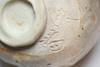
The bold, rhythmic brushstrokes of the underglaze iron painting depict a rustic motif, infusing the timeless Shino aesthetic with dramatic vitality. On the bottom next to the foot, the bowl features the artist's distinctive hand-carved signature ("herabori"), which serves as the hallmark of authentic Kuro family lineage. This piece represents the pinnacle of samurai-tea aesthetics from nineteenth-century Japan, offering both profound historical value and undeniable artistic presence for any refined collection.
Hirasawa Kuro
1772-1840
male
seto pottery
A samurai of the Owari Domain during the late Edo period. He was born in the 9th year of the Meiwa era as the son of Tadamasa. In the 3rd year of the Kansei era, he became a personal page (soba-koshō) to the domain lord, Tokugawa Munechika, and in the 8th year of the same era, he transitioned to the position of konando (inner chamberlain) while concurrently serving as an okuban (inner guard). In the 11th year of the same era, he inherited his late father’s estate and was granted a stipend of 400 koku (equivalent to an annual supply of rice for 400 adults). In the 1st year of the Kyōwa era, he was appointed as a supervisor (yōnin) for the Takasu Domain, but in the following year, he fell ill and retired, passing the headship of the family to his eldest son, Kazutane.
After his retirement, he moved to the Kogangaya Yōrō-en estate located on Kiyomizu-zaka, where he began practicing the tea ceremony and ceramics in earnest. His residence featured two tea rooms, “Konjaku-an” and “Kyū-an,” where he enjoyed the tea ceremony of the Uraku school. He is known to have had diverse associations that transcended school boundaries, socializing with various tea masters such as Hirao Kazuya (Head of the Owari Domain Tea Rooms), Matsuo Sōgo (the 5th generation head of the Matsuo school), Kobori Sōchū (the 8th generation head of the Enshū school), and Fuzō-an Ryūkei.
His talent in pottery was already highly acclaimed during his lifetime, and records of tea gatherings attended by Kuro include descriptions such as “Mizusashi (water jar), Seto ware, made by Kuro.” In addition to Seto glazes (iron glazes), he produced works in various styles, including Shino, Oribe-guro (Black Oribe), Oribe, Ki-Seto (Yellow Seto), and Karatsu.
Although he was originally a samurai, Kuro maintained deep connections with various potters. Among them, he shared a particularly close and intimate friendship with Katō Shuntai, who is widely celebrated as one of the finest Seto master-potters of the early modern era, and there are numerous surviving pieces believed to have been crafted with Shuntai’s assistance.
Kuro’s eldest son, Kazutane, to whom he had passed the family headship, passed away at a young age, so his second son, Amasumi, succeeded the Hirasawa family and assumed the name “Kuro,” just like his father. He was also deeply versed in the tea ceremony and appears to have inherited his father’s talent for ceramic art.