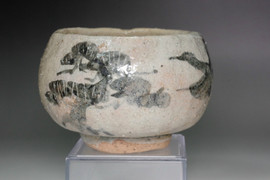
Munakata Shiko (1903–1975) Vintage Japanese teabowl #5511
- SKU:
- 5511
- Condition:
- Used
- Shipping:
- Free Shipping



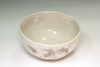


width: approx. 12 cm (4.7 in)
height: approx. 6.7 cm (2.6 in)
weight: approx. 239g (w/ box 546g)
Information from the previous owner: Acquired from an antique dealer in Kagawa, Japan.
Munakata Shiko
(1903–1975)
Munakata Shiko was born in Aomori as the third son of Yukichi Munakata, a swordsmith, and his wife Sada, in a family of fifteen children. After graduating from elementary school, he immediately began helping with the family business and was therefore unable to attend middle school. Having grown up in a region of heavy snowfall, he developed an eye illness from the soot of the irori hearth, which left him with severe myopia for the rest of his life.
In 1924, at the age of 21, he moved to Tokyo. He submitted oil paintings to the Teiten (Imperial Art Exhibition) and the Hakujitsukai Exhibition, but was repeatedly rejected. In 1928, he was accepted to the 9th Teiten. In 1930, he worked as an art teacher at Bunka Gakuin. In 1932, he became a member of the Nihon Hanga Kyokai (Japan Print Association). In 1936, his work Yamato shi Uruwashi, exhibited at the Kokugaten, became his breakthrough piece. This led to exchanges with leading figures of the Mingei movement, including Soetsu Yanagi and Kanjiro Kawai, who had a profound influence on Munakata’s art.
In 1956, he exhibited at the Venice Biennale and became the first Japanese artist to receive the International Print Grand Prize in the printmaking division. In 1970, he was awarded the Order of Culture. He died in Tokyo in 1975 of liver cancer at the age of 73, and was posthumously awarded the Junior Third Rank.
As a boy, Munakata encountered the paintings of Vincent van Gogh and was so deeply moved that he resolved to become “a Van Gogh.” Because of his extreme nearsightedness, he carved his woodblocks with his face so close that his glasses nearly touched the board. During World War II, while evacuated to Toyama Prefecture, he came into contact with Jodo Shinshu Buddhism, which inspired him to create many works based on Buddhist subjects.
Munakata’s art is marked by dynamic forms and overflowing vitality. His works, which earned him the title “Munakata of the World,” embody a bold and powerful world of originality that is instantly recognizable to any viewer as the work of Munakata Shiko. In his polychrome woodblock prints and hand-painted works alike, his remarkable sense of color is fully expressed. His hand-painted works are known as Yamato-e and, like his woodblock prints, are held in very high regard.