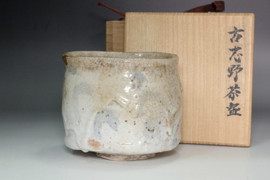
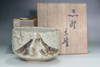
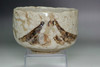
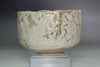
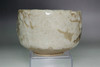
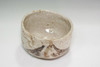
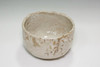
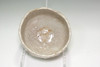
Yano Keisen (1872-1965) Vintage Japanese Shino ware "Mt. Fuji" Matcha Chawan teabowl #5612
- SKU:
- 5612
- Condition:
- Used
- Shipping:
- Free Shipping


Yano Keisen (1872-1965)
Born in Kozoji-cho, Kasugai City, Aichi Prefecture—a place illuminated by the glowing red fires of pottery kilns—a man dedicated his life to working with clay. Born in 1897 as the second son of Nagae Shotaro, he would go on to become a ceramic artist who captivated many of the great figures of his time, even as Japan navigated the turbulent currents of its history and culture.
A pivotal moment arrived in 1942—a year of great upheaval. To celebrate the 88th birthday (beiju) of Toyama Mitsuru—a prominent leader of Japan’s right-wing and Pan-Asianist movements from the Meiji through the Showa eras—the artist crafted a tea bowl into which he poured his entire being. Deeply moved by the intensity and refinement of the piece, Toyama bestowed upon him the art name "Keisen" (kei means scenery, sen means river). It was the moment his craft—the act of breathing a soul into a lump of clay—was recognized by a major figure of the era.
In 1952, as the chaos of the post-war period began to subside, Keisen encountered another significant connection. He created a tea bowl to mark the 77th birthday (kiju) of Takashina Rosen, a high-ranking Zen monk who served as the head of Eiheiji (the head temple of the Soto school) and as president of the Japan Buddhist Federation. Struck by the serene beauty of the bowl—a quality resonant with the spirit of Zen—Takashina gifted him the character "sen" (means hermit) from his own name. Receiving this character from two such eminent mentors—one a titan of the political world, the other a pinnacle of the Buddhist world—seemed to symbolize his destiny as a potter.
Keisen’s reputation eventually spread into the realms of literature and the arts. In 1955, his first solo exhibition was held in Tokyo, organized by such literary giants as Kawabata Yasunari—who would later win the Nobel Prize in Literature—and Osaragi Jiro, a master of historical fiction. Artists of the written word discovered, within the negative space of the vessels crafted by Keisen, narratives that transcended mere language.
In 1956, Keisen held a solo exhibition in his home city of Nagoya, hosted by the Chubu Business News Paper. The following year, 1957, he participated in a joint exhibition in the same city alongside the renowned literary figure Saneatsu Mushanokoji and the world-acclaimed printmaker Munakata Shiko. Standing shoulder to shoulder with these iconic creative figures of the era, Keisen’s pottery exuded a quiet yet undeniable presence.
Then, in 1959—a time when all of Japan rejoiced in the wedding of the Crown Prince—Keisen was entrusted with a prestigious honor: he created and presented to the Imperial Household a Shin ware tea bowl—a piece embodying the Mino tradition dating back to the Momoyama period, characterized by a warm white glaze accented with striking, scarlet-hued scorch marks.
His spirit of inquiry extended well beyond the confines of his hometown, Kasugai. Seeking to continue the lineage of "Konan ware"—a ceramic tradition that first emerged in Otsu in 1851—Keisen dedicated himself to the craft in Otsu, working with the earth found along the shores of Lake Biwa.
Throughout his later years, Yano Keisen—who devoted his entire life to clay and fire—held numerous solo and joint exhibitions at venues such as the Maruei and Meitetsu department stores in Nagoya. Until his passing in 1965, the tea bowls born from his hands were held and warmed by the palms of great figures who shaped their era; even today, those pieces continue to radiate a quiet, enduring light.
width: approx. 11.5cm (4.5in)
height: approx. 8cm (3.1in)
weight: approx. 353g (w/ box 570g)
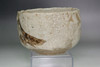
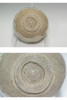
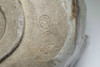
condition: good (shows natural crackle in the glaze, pinholes, and kiln marks inherent to the firing process; please refer to the photos for detailed condition)
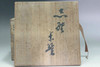
Accessories: original wooden box (Tomobako). Items not pictured and photography props are not included.
Shipping: Shipped from Japan with a tracking number. We take great care in professional packaging to ensure the item arrives safely.